The 5 Best LED Face Masks of 2026, Ranked by the Numbers
Most LED masks underdeliver for one reason: they're underpowered, or they don't reach the skin they're supposed to treat. So we skipped the hype and compared what's on the spec sheets — wavelengths, LED count, power output, facial coverage, and what happens if it doesn't work for you.

LuminX Pro by VogueNow
- 4 clinically studied wavelengths — the only mask here that combines red, near-infrared, deep near-infrared and blue light
- 280 LEDs, up to 50 mW/cm² — the highest published power output in this comparison
- Covers what others miss — integrated lip treatment and an extended chin strap for the jawline
- 100-day money-back guarantee — more than 3× the return window of any other mask on this list
- $299.97 — $170 less than the most expensive mask we compared
How we ranked them
Every mask below was scored on the same five criteria, using each manufacturer's own published specifications — not marketing claims. Where a brand doesn't publish a figure, we say so.
Before you buy: the 4 numbers that matter
Wavelengths (nm). Red light (~630nm) stimulates collagen — the protein responsible for firm, smooth-looking skin. Near-infrared (~850nm) works deeper. Deep near-infrared (1072nm) reaches deeper still. Blue light (~465nm) targets acne-causing bacteria. A mask with only red and NIR simply cannot treat breakouts. Check which wavelengths a mask actually has before assuming it treats your concern.
Irradiance (mW/cm²). This is the power actually delivered to your skin — and the number brands most often leave off the box. Two masks with identical wavelengths can deliver very different doses. If a brand doesn't publish irradiance, you can't compare it.
Coverage. LED count matters, but so does where the light lands. Most masks stop short of the lips, chin and jawline — precisely the areas prone to sagging and early lines. A rigid shell that sits off the skin's curves loses dose exactly where you need it.
The guarantee. LED therapy needs consistent use over weeks — every reputable brand says so. The honest question is: what happens if you use it consistently and don't see results? A 30-day window barely covers the first visible changes. A longer window is the brand betting on its own device.
The rankings
LuminX Pro — VogueNow
Best Overall 2026
The LuminX Pro won this comparison on the numbers, not the branding. It's the only mask in the lineup that combines all four therapeutic wavelengths — red 630nm, near-infrared 850nm, deep near-infrared 1072nm and blue 465nm — so one device covers fine lines, firmness and breakouts. Its published output reaches 50 mW/cm² on Balance mode, the highest figure disclosed by any brand here, delivered through 280 LEDs in a flexible mask that weighs just 174g.
What sets it apart in daily use is coverage. The mask includes an integrated lip treatment and an extended strap that pulls LED coverage down over the chin and jawline — areas where most masks simply stop. In a 2025 clinical study published in Medicine journal, 89.3% of participants saw visible wrinkle reduction after 12 weeks of consistent use.
And the risk math is one-sided: a 100-day money-back guarantee — long enough to actually complete the 8-week protocol and judge your results — plus a 2-year warranty as standard (purchases through August 31, 2026 currently get a third year free).
Pros
- Only mask here with red + NIR + deep NIR + blue in one device
- Highest published irradiance in this comparison (50 mW/cm²)
- Lip and chin/jawline coverage others don't offer
- Clinical study: 89.3% saw visible wrinkle reduction (12 weeks)
- 100-day guarantee + 2-year warranty
Cons
- Results require consistency — 10 minutes, 4–5 nights a week, for at least 4 weeks
- 10-minute sessions vs. the 3-minute cycles of some rivals
- Sold through VogueNow only, not in retail stores
CurrentBody Skin LED Mask: Series 2
Premium Pick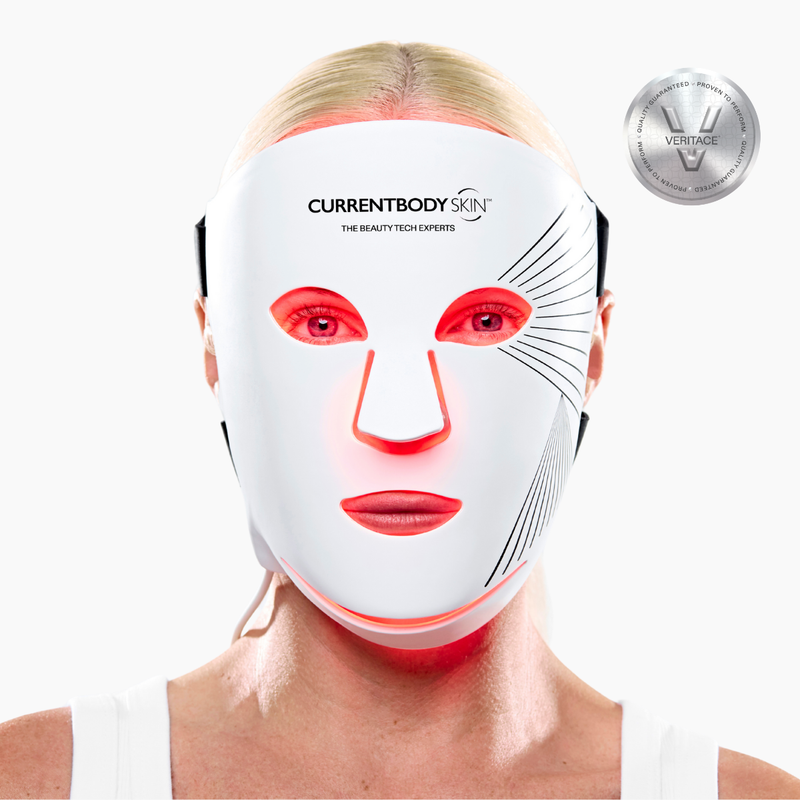 Editorial illustration
The best-known premium mask in the category, and a strong device: 236 LED bulbs across three wavelengths — red 633nm, near-infrared 830nm, and 16 deep near-infrared 1072nm bulbs — at a published 30 mW/cm². The Series 2 redesign improved chin and jaw fit over the original.
Pros
- Includes deep near-infrared (1072nm) — rare in the category
- High LED count and solid published power output
- Improved chin/jaw fit vs. Series 1
Cons
- No blue light — can't target acne-causing bacteria
- Most expensive mask in this comparison
- 60-day return window vs. LuminX Pro's 100
Available at currentbody.com — specs above from the brand's US product page, checked Aug 5, 2026.
Omnilux Contour Face
Most Recognized Editorial illustration
The name dermatologists mention most, built on a simple, proven combination: red 633nm and near-infrared 830nm through 132 LEDs at ~30 mW/cm², in a flexible, rechargeable design. What it does, it does well — the question is how much it leaves out.
Pros
- Strong brand heritage and 2-year device warranty
- Flexible, rechargeable, well-reviewed fit
- Fair price for the premium tier
Cons
- Only 2 wavelengths — no blue light, no deep NIR
- Lowest LED count of the premium masks here (132)
- 30-day money-back window is tight for an 8-week protocol
Available at omniluxled.com — specs above from the brand's official product page, checked Aug 5, 2026.
Dr. Dennis Gross DRx SpectraLite FaceWare Pro
The Original Hard Shell Editorial illustration
The mask that made LED famous on social media. 100 red and 60 blue lights in a rigid shell, with a 3-minute pre-programmed cycle. The short sessions are a real convenience win — but a hard shell can't follow the curves of every face, and where the mask lifts off the skin, dose is lost.
Pros
- Treats both aging and acne (red + blue)
- Fast 3-minute automated sessions
- FDA-cleared, dermatologist-founded brand
Cons
- Rigid shell — contact and coverage vary by face shape
- Irradiance not published, so dose can't be compared
- 1-year warranty and 30-day window at a $455 price
Available at drdennisgross.com and retailers — specs above from the brand's official product page, checked Aug 5, 2026.
Qure Q-Rejuvalight Pro
App-Controlled Pick Editorial illustration
The tech-forward option: five listed wavelengths (415, 605, 630, 660, 880nm), app-customizable across five facial zones, 3-minute sessions, rechargeable. On paper the wavelength list is impressive — but with 160 dual-core LEDs sharing that workload and no published irradiance, it's impossible to know what dose each wavelength actually delivers.
Pros
- Widest wavelength menu on this list
- App control with zone-by-zone customization
- Quick 3-minute sessions, app-controlled
Cons
- Power output not published — dose per wavelength unknown
- Fewer LEDs than LuminX Pro or CurrentBody, at a higher price than the former
- 1-year warranty, 30-day money-back window
Available at qureskincare.com — specs above from the brand's official product page, checked Aug 5, 2026.
Side by side: the full spec comparison
Swipe the table sideways to see every column →
| Spec | LuminX Pro | CurrentBody S2 | Omnilux Contour | Dr. D. Gross | Qure Pro |
|---|---|---|---|---|---|
| Price (USD) | $299.97 | $469.99 | $395 | $455 | $399 |
| Wavelengths | 4 — red, NIR, deep NIR, blue | 3 — red, NIR, deep NIR | 2 — red, NIR | Red, NIR, amber, blue | 5 listed |
| Blue light (acne) | ✓ 465nm | ✗ | ✗ | ✓ 415nm | ✓ 415nm |
| Deep NIR 1072nm | ✓ | ✓ (16 bulbs) | ✗ | ✗ | ✗ |
| LED count | 280 | 236 | 132 | 160 | 160 dual-core |
| Max irradiance | Up to 50 mW/cm² | 30 mW/cm² | ~30 mW/cm² | Not published | Not published |
| Lip treatment | ✓ Integrated | Not stated | Not stated | Not stated | Not stated |
| Chin/jawline strap | ✓ Extended strap | Improved fit | ✗ | ✗ | ✗ |
| Session | 10 min | 10 min | 10 min | 3 min | 3 min |
| Money-back window | 100 days | 60 days | 30 days | 30 days | 30 days |
| Warranty | 2 years* | Not stated on page | 2 years | 1 year | 1 year |
| FDA-cleared | ✓ | ✓ | ✓ | ✓ | ✓ |
All specifications taken from each manufacturer's official product page, checked August 5, 2026. Specifications and prices may change — verify on the brand's site before purchase. *LuminX Pro purchases through August 31, 2026 include a bonus third year of warranty.
One mask won on every criterion that can be measured.
Four wavelengths. 280 LEDs. The highest published power output in the comparison. Lip-to-jawline coverage. And 100 days to see the results on your own skin — or pay nothing.
See LuminX Pro — $299.97 →The guarantee gap nobody talks about
Every brand on this list tells you LED needs weeks of consistent use. Visible changes typically start around week 2–4; structural changes around week 8. Now look at how long each brand gives you to judge the results:
A 30-day window expires before the 8-week protocol is even half done. Only one brand's guarantee outlasts its own results timeline — which tells you something about how confident it is in that timeline.
LED mask questions, answered honestly
Do LED face masks actually work?
The underlying science — photobiomodulation, or light-triggered cellular repair — is supported by decades of clinical research. Red light around 630nm stimulates collagen production; blue light around 415–465nm targets acne-causing bacteria. But results depend on three things: the right wavelengths, sufficient power (irradiance), and consistent use over weeks. A mask that's underpowered, or that you stop using after week 2, will not deliver. For reference: in a 2025 clinical study published in Medicine journal, 89.3% of LuminX Pro participants saw visible wrinkle reduction after 12 weeks of consistent use.
How long until I see results?
Honest timeline, consistent across the category: calmer, smoother-feeling skin around week 2; visible glow around week 4; measurable changes in fine lines and firmness around week 8. Any brand promising overnight results is overpromising. This is also why the money-back window matters — 30 days isn't long enough to judge an 8-week process.
Why does irradiance matter so much?
Irradiance (measured in mW/cm²) is how much light energy actually reaches your skin. Wavelength determines what the light does; irradiance determines how much of it gets done per session. Two masks with identical wavelength lists can deliver very different doses. That's why we flag brands that don't publish the figure — without it, comparison is guesswork.
Is a flexible mask better than a hard shell?
Light dose falls off quickly with distance. A flexible mask that sits close to the skin across the face's curves delivers more consistent dose than a rigid shell that bridges over them. Hard shells aren't ineffective — but fit varies more from face to face, and areas like the chin and jawline are usually the first to lose contact.
Are LED masks safe?
The masks in this comparison are FDA-cleared, and LED light therapy is non-invasive with no downtime. Look for eye-safe certification (the LuminX Pro carries one). If you're pregnant, taking photosensitizing medication, or have a diagnosed skin condition, check with your doctor first — that's standard guidance for any light therapy device.
Why is LuminX Pro your top pick over better-known brands?
Because the spec sheet wins. It's the only mask in this comparison combining red, near-infrared, deep near-infrared and blue light in one device; it has the most LEDs (280) and the highest published power output (up to 50 mW/cm²); it treats lips and jawline, which the others don't claim to; and its 100-day money-back guarantee is more than three times longer than most rivals'. Brand recognition is real — but it doesn't change what the numbers say. Every figure is on the brands' own product pages; check them yourself.
The bottom line
If you want the most complete LED mask that 2026 has to offer — the widest useful wavelength coverage, the strongest published power, coverage from lips to jawline, at a mid-range price and with a guarantee long enough to actually mean something — the numbers point one way.