LED Face Masks in 2026: What Actually Decides Whether You See Results
Eight of the most heavily advertised at-home LED masks in the US, checked line by line against what each manufacturer actually publishes. The differences that matter are not the ones the ads are shouting about — and one of them costs you nothing to check before you buy.
By The Skin Device Report editorial teamPublished 5 August 202614 min read
How we make money. The Skin Device Report is funded by commercial partnerships. This guide was produced in partnership with VogueNow, the maker of one of the devices reviewed below, and we may earn a commission if you buy through a link on this page. Every specification quoted here comes from the manufacturer's own published materials and is dated and sourced at the bottom of this page so you can check it yourself. We do not publish figures a brand has not published.
Every LED mask sold in the United States says the same three things: FDA cleared, clinically tested, dermatologist developed. All three are usually true. None of them tells you whether the device will work on your face.
Here is the part nobody putting an ad in front of you wants to lead with. The American Academy of Dermatology — not a brand, not a retailer — states it plainly on its own public website:
“FDA cleared doesn't tell you anything about how effective the device is. It means the device is considered safe.” American Academy of Dermatology1
That single sentence dismantles the most-used trust badge in this category. A 510(k) clearance is a submission demonstrating that a device is substantially equivalent to something already on the market.2 It is a safety and equivalence process, not an efficacy trial. Which means the badge every brand puts in its headline is the one thing that cannot separate them.
So what does separate them? After reading every published spec sheet, warranty page and returns policy for the eight masks below, it comes down to seven things — and four of them are buried where you would have to go looking.
The complaint pattern in this category is remarkably consistent across retailer reviews and skincare forums, and it splits three ways.
It was uncomfortable, so it stopped being used. Every published trial on LED photobiomodulation shares one requirement: repeated sessions over weeks. Lee et al. ran twice-weekly sessions for four weeks to record a 36% wrinkle reduction.3 Wunsch and Matuschka ran 30 sessions across roughly 15 weeks to record increased collagen density.4 A mask that is heavy, rigid or has to stay plugged into a wall socket does not get worn 30 times. Compliance is not a soft factor here — it is the mechanism.
The results never showed up where she wanted them. The jawline, the chin and the area around the mouth are where most people first notice change — and where most masks simply do not reach.
The expectations were wrong from day one. The AAD is blunt about this too: "This is not a one-and-done treatment… it takes time to see the results and not everyone sees them."1 Brands that promise week-one transformation manufacture their own refund requests.
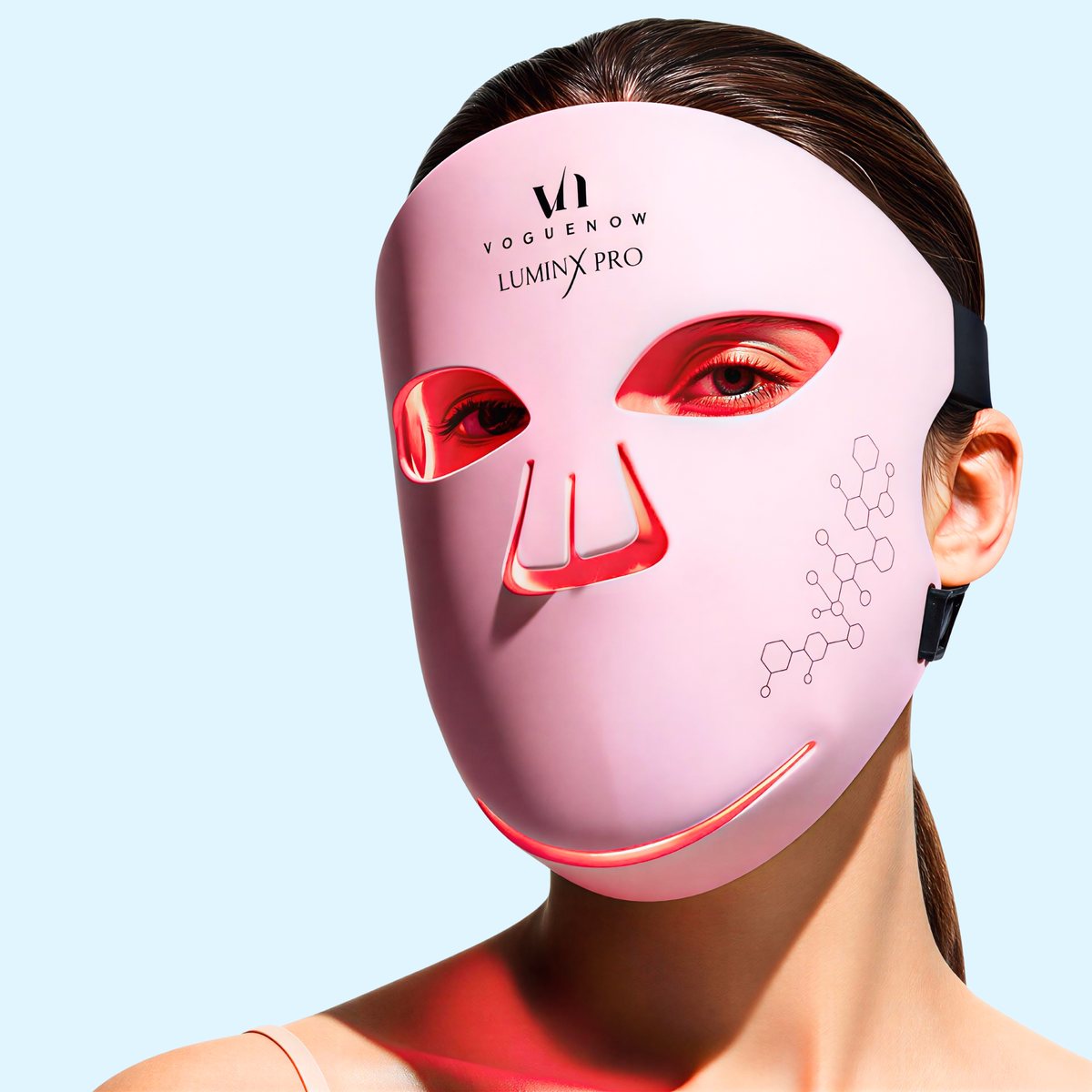
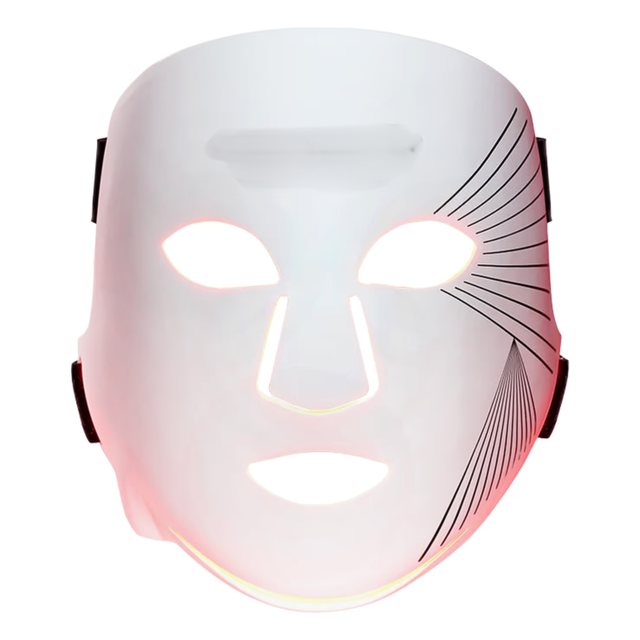
What a full-coverage session actually looks like: light reaching the jawline and the perioral area, not just the cheeks and forehead. Pictured: VogueNow LuminX Pro.
The seven things worth checking before you spend $350–$650
Each one is verifiable from a manufacturer's own website in under two minutes.
1Coverage: find out where it stops
This is the least discussed and most consequential difference. Nearly every mask in this guide is marketed as "full face" — but "full face" is not a defined term. Read the fine print and the picture changes: CurrentBody sells a separate LED Neck & Décolletage mask.5 Dr. Dennis Gross sells separate LipWare Pro and EyeCare Max Pro devices.6 Solawave sells a separate Neck & Chest mask at $349.7 Therabody publishes no neck coverage for its mask at all.8
None of that is dishonest. But if the jawline and the perioral area are your reason for buying, you are being sold the coverage twice.
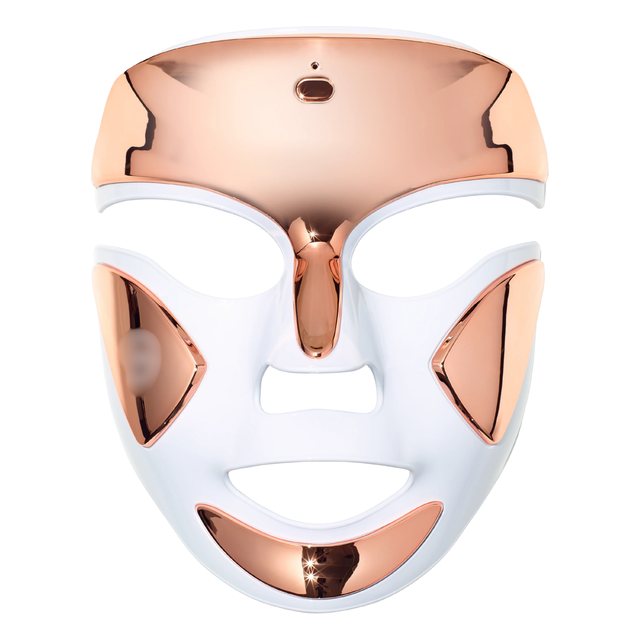
Typical at-home LED masks — generic examples, not any of the eight devices reviewed below
Look at the bottom edge of each one. That line is where the light stops. On most masks in this category it falls at the cheekbone or just under the chin — above the jawline, and well above the area around the mouth. This is the single most useful thing to check on a product page, and the thing brands are least likely to state in writing.
What to do: open the product page and search it for the words chin, jawline and lips. If the manufacturer does not claim those zones in writing, assume the device does not treat them.
2Wavelengths: four jobs, four different depths
Wavelength determines how deep the light reaches and therefore what it can act on. The published picture, in plain terms:
Blue, roughly 415–465 nm. Barely penetrates — it works in the epidermis.9 Its documented job is acne: blue light photo-excites porphyrins produced by C. acnes, destroying the bacteria.10 In a 107-patient trial, combined blue-and-red phototherapy produced a mean 76% improvement in inflammatory lesions at 12 weeks, beating benzoyl peroxide.11 If you break out, a mask with no blue LEDs cannot help with that at all.
Red, roughly 630–660 nm. Reaches the dermis and activates fibroblasts — the collagen story.9 Red light is largely extinguished around 4–5 mm beneath the surface.12
Near-infrared, roughly 830–850 nm. The deepest-reaching band in routine use.9 Combined 633 nm + 830 nm is the exact pairing behind the 36% wrinkle-reduction result in Lee 2007.3
Deep near-infrared, around 1072 nm. Rare in at-home devices. It penetrates further still, and is the newest of the four — a 2023 review notes clinical research at 1072 nm remains limited.13 Treat it as a genuine engineering advantage, not as settled proof.
What to do: count the bands, and check whether blue is among them. Two of the best-known premium masks in this guide — CurrentBody Series 2 and Omnilux Contour Face — publish red and near-infrared only. Excellent for lines. Nothing for breakouts.
3Irradiance: the number to check, and the number to distrust
Irradiance (mW/cm²) is how much light power actually lands on your skin. It matters — and here is the part the "more power" ads leave out. The photobiomodulation literature documents a biphasic dose response: "low levels of light have a much better effect on stimulating and repairing tissues than higher levels of light."14 The follow-up paper is blunter still: "more does not necessarily mean better… too much power density and/or time may have inhibitory effects."15 In one documented case, raising the dose tenfold made the benefit disappear entirely.15
For perspective: the trials that produced the headline results in this field ran at roughly 6–13 mW/cm².416 Reviews of the dermatology literature point to a working range under about 100 mW/cm².17
What to do: check whether the brand publishes irradiance at all. Four of the eight masks here do not publish a figure anywhere. That is the more telling signal — a brand that will not print the number is asking you to take the most important variable on faith.
4Weight and material: the compliance test
This is where the published numbers get genuinely startling. Therabody publishes 576 g for the TheraFace Mask, built from PC+ABS and PC — rigid plastics.8 Shark publishes 1.5 lb for the CryoGlow.18 CurrentBody's product page lists a product weight of 1220 g ± 10 g.5 At the other end, VogueNow publishes 174 g for the LuminX Pro.19
Whether you can lie down, cook dinner or fold laundry in the thing decides whether it gets used four nights a week for eight weeks. Given that every result in the literature depends on repetition, this unglamorous spec may be the strongest single predictor of whether you ever see a result.
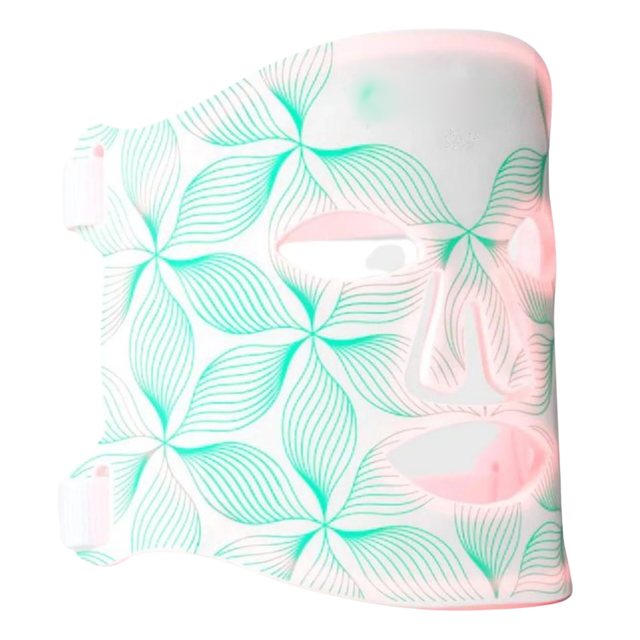
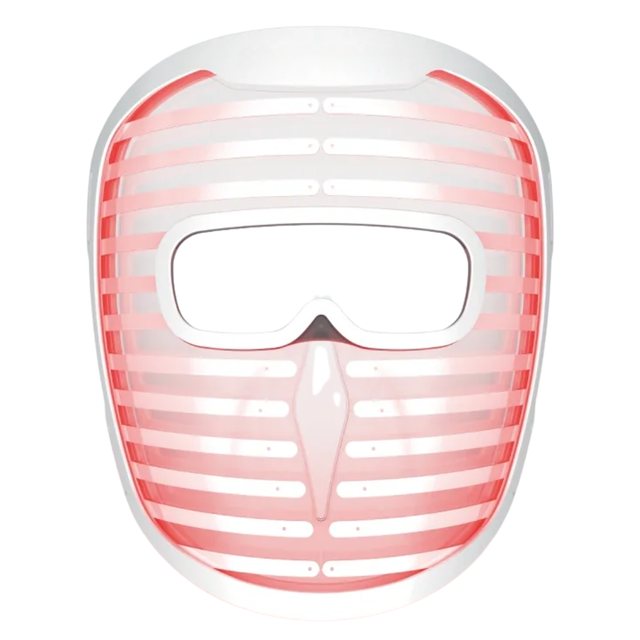
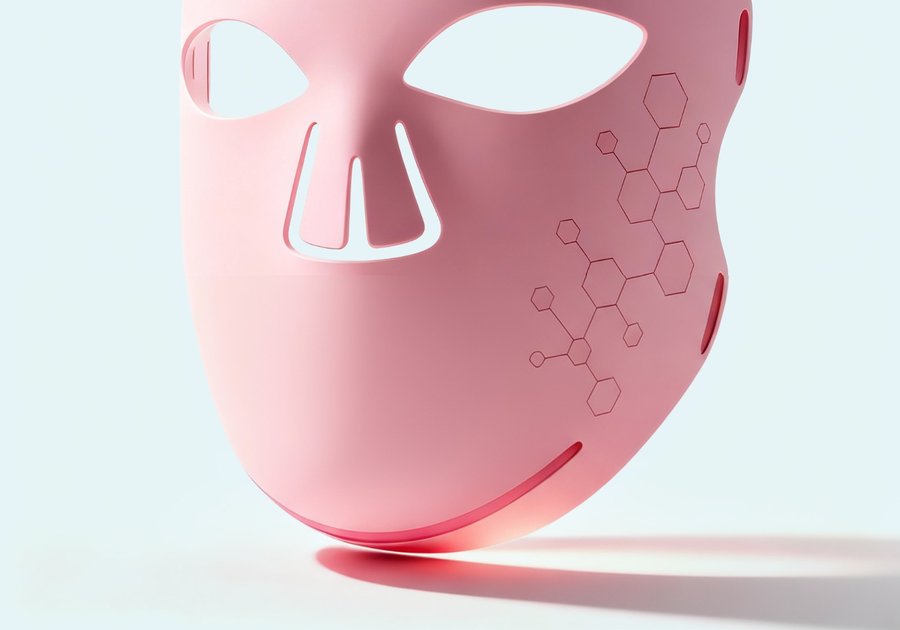
Left: rigid shell · Right: flexible body — generic examples, not any of the eight devices reviewed below
A rigid shell rests on the face at a few contact points; a flexible body conforms to it. That difference decides both how comfortable the thing is to wear and how evenly the LEDs sit against the skin — and comfort is what determines whether you are still using it in week six.
What to do: find the published weight and the material. Flexible medical-grade silicone that conforms to the face beats rigid plastic that rests on it — both for comfort and for keeping the LEDs at a consistent distance from the skin.
5Session length: does the protocol match the research?
Sessions in this guide range from 3 to 10 minutes, and shorter is marketed as more convenient. But the published protocols behind the results are not three-minute protocols: Lee 2007 used twice-weekly sessions over four weeks;3 the 2025 sham-controlled mask trial used 21-minute sessions;16 Wunsch used 30 sessions over roughly 15 weeks.4 Time under the light is part of the dose.
What to do: treat a very short session as a convenience feature, not as evidence of a more powerful device. And check the recommended frequency: 3–5 times a week is the norm across the category, and it is the figure the studies support.
6"FDA cleared": what it actually covers
Every mask in this guide states FDA clearance. Only one — Qure — publishes its actual clearance number (K230042) and the indication it covers.20 A 510(k) clearance demonstrates substantial equivalence to a device already on the market; it is not the premarket approval process that Class III devices go through.2 The AAD's summary stands: it speaks to safety, not efficacy.1
What to do: take the badge as table stakes, not as a differentiator. If a brand publishes its clearance number and indication, that is a small point in its favour — it means you can look it up.
7The returns policy — read this one twice
This is the trap in the category, and on one major brand it is hiding in plain sight on its own policy page.
CurrentBody publishes a 30-day return window with the condition that "the item must be new and unused, with all the original accessories, free gifts, packaging and manufacturing seals intact." Its list of items it will not accept includes "all devices which are opened, used, or security seal is not intact."21 The only route to a refund on a used device is a failed sensitivity patch test, returned within 14 days.21
Read that in the context of a category where the manufacturers themselves tell you results take four to twelve weeks. A window that closes the moment you break the seal is not a trial period. It is a shipping-damage policy.
The rest of the field is more honest about it, but the windows are still short: Omnilux gives 30 days on devices with a $15 return fee and the original box required;22 Dr. Dennis Gross, Therabody and Qure give a straight 30 days; Shark and Solawave give 60.
What to do: find the words unopened, unused and seals intact before you check out. Then compare the window to the brand's own stated results timeline. If the guarantee expires before the results are supposed to arrive, you are carrying all of the risk.
The eight masks, side by side
Every figure below is taken from the manufacturer's own published materials and was checked on 5 August 2026. Where a brand publishes nothing, the cell says so — we have not estimated. Prices are US list prices and change often.
← Swipe the table sideways to see all eight devices.
Solawave price. $399 is the list price. A "Buy 1, Get 1 Free" offer was running on Solawave's own product page on 5 August 2026, which works out at roughly $199.50 per mask if you buy two. Check before you compare on price.7
Qure price. $399 is the list price. Qure's own product page displays "Get $100 with code QURE100", so the effective price on the day we checked was about $299.20
Dr. Dennis Gross wavelengths. These figures appear in the brand's device manual and in a comparison table on the product page. Both lists include amber and near-infrared, which the same page's own description of the device — "100 red lights… 60 blue lights" — does not support. There is no clean, device-level wavelength statement anywhere on the brand's own properties.6
Shark's blue figure. Shark's own product pages list "Red 630nm, Infrared 830nm, Blue 630nm". 630 nm is red light, so the blue figure appears to be an error on the manufacturer's page rather than a specification. We checked three Shark product URLs on 5 August 2026 and all three printed it. We are not going to guess at what it should say.18
Solawave coverage. The product page lists forehead, frown lines, eye area, cheeks and smile lines. The jawline claim appears only in Solawave's help centre. Neither source claims chin or lip coverage.728
Qure frequency. Qure's FAQ says "you only need to use it once per day." Its quickstart guide says "We recommend using it at least 3–5 times per week for best results." Both are live on the brand's own site.20
CurrentBody weight. 1220 g ± 10 g is the figure in CurrentBody's own field labelled "Product Weight". The brand does not state whether it includes the controller or packaging, so neither do we. Weights across this table may be measured differently by each brand.5
CurrentBody returns. 30 days, with the condition that "the item must be new and unused, with all the original accessories, free gifts, packaging and manufacturing seals intact." The brand's list of items it will not accept includes "all devices which are opened, used, or security seal is not intact." A separate 14-day route exists only for a failed sensitivity patch test.21
Omnilux returns. Omnilux's device policy is a 30-day return window; returns of an LED device "will be subject to a $15 USD return fee" and "must include the original box, as well as accessories and parts supplied." Opened devices are accepted. (Omnilux's separate "no returns on open product" rule applies to its topical skincare, not its devices.)22
Sources for every cell are listed and linked at the bottom of this page. Weights are as published by each manufacturer and may be measured differently between brands. "No information published" means we could not find the figure in the brand's own materials on 5 August 2026 — it does not mean the device lacks the feature.
The eight masks, reviewed
Ordered by how well each one answers the seven checks above.
How to read the diagrams
Every device below is drawn the same way, from that manufacturer's own published figures — including our commercial partner's. Nobody gets a photograph, so nobody gets a photographic advantage.
Dot count follows the published LED count.
Dot colour follows the published wavelengths: blue ~415–465 nm amber ~605 nm red ~630 nm deep red ~660 nm near-infrared ~830–880 nm deep near-infrared ~1072 nm
Body is soft-edged where the brand publishes flexible silicone, hard-edged where it publishes rigid plastic, and neutral where it publishes no material.
Weight appears beneath the device only where the brand publishes one.
A mask with no blue dots is a mask its maker does not claim treats breakouts. That is the point of drawing them this way.
Best overall — and the only one that treats the jawline, chin and lips
VogueNow LuminX Pro
$299.97 · 4.8 out of 5 from 179 reviews on the brand's site19
Illustration — not a photograph280 LEDs published; colours show the published 630 / 850 / 1072 / 465 nm — the only device here with both blue and deep near-infrared. Flexible silicone body as published.
Wavelengths
630 / 850 / 1072 / 465 nm
LEDs
280
Irradiance
up to 50 mW/cm²
Weight
174 g
Session
10 min, 4–5×/week
Guarantee
100 days
LuminX Pro is the only device in this guide whose manufacturer explicitly publishes coverage of the chin, the jawline and the lips — the three zones every other brand in this list either omits or sells you separately.19 It does it with an extended strap that carries light down past the jaw and an integrated lip section, rather than by making the face plate bigger.
The wavelength set is the other reason it sits at the top. Four bands — red 630 nm, near-infrared 850 nm, deep near-infrared 1072 nm and blue 465 nm — across four modes, so a single device covers both the collagen story and the breakout story. CurrentBody has the deep near-infrared but no blue. Omnilux has neither. Solawave has four bands but no blue. On the published specs, this is the only mask here that does all four jobs.
At 174 g of flexible silicone it is, by a wide margin, the lightest device in this guide — roughly a third of the published weight of the TheraFace Mask and a fraction of CurrentBody's published figure. Given that every result in the research depends on repetition, that is not a comfort footnote; it is the compliance argument.
And the guarantee is the outlier of the whole category: 100 days, money back, against 30 days elsewhere — and against the two premium brands that only accept returns if the box is still sealed. Backed by a 2-year warranty, currently 3 years on orders placed between 1 July and 31 August 2026.19
Strengths
Only device here with published chin, jawline and lip coverage
Four wavelengths including both blue 465 nm and deep NIR 1072 nm
174 g — the lightest in this guide by a large margin
100-day money-back window, opened and used
2-year warranty (3 years in the current purchase window)
Publishes its irradiance figure — most of this category does not
Trade-offs
The $299.97 price is promotional — the brand's stated regular price is $499.97
10-minute session, not the 3-minute of Solawave or Qure
Its clinical figure comes from a published study of the modality, not an in-house trial of this exact device
Newer brand than Omnilux or Dr. Dennis Gross
Who it's for: anyone whose reason for buying is the lower third of the face — jawline slackening, the lines around the mouth, thinning lips — and anyone who wants one device to handle both lines and breakouts. Also the right pick if you have been burned before and want a return window that outlasts the results timeline.
Specifications above checked 5 August 2026 on VogueNow's product page — this is our commercial partner, disclosed at the top of this page.
Ships from the US · 2-year warranty · 4.8/5 from 179 reviews
Best documented results — if lines are your only concern
CurrentBody Skin LED Face Mask: Series 2
$469.99
Wavelengths
633 / 830 / 1072 nm
LEDs
236
Irradiance
30 mW/cm²
Session
10 min, 3–5×/week
Warranty
2 years
Returns
30 days, unopened
Illustration — not a photograph236 LEDs published; colours show the published 633 / 830 / 1072 nm. Flexible silicone body as published. No blue light published.
The most-cited mask in the category, and it earns much of that. CurrentBody publishes a 56-day study on the Series 2 with results down to the measurement instrument — biological elasticity +57.1%, forehead wrinkle volume −29.8%, crow's feet −25.7%.5 Very few brands in this category publish at that level of detail.
It is also one of only two masks here carrying deep near-infrared at 1072 nm. What it does not carry is blue — so it has nothing to offer acne. Neck and décolletage are a separate purchase. And the published product weight of 1220 g ± 10 g is the heaviest figure in this guide.5
Strengths
The most detailed published clinical data in the category
Most expensive of the mainstream options at $469.99
Who it's for: a buyer focused purely on fine lines and firmness, who wants the deepest published evidence file and is confident enough not to need a real trial period.
Specifications above checked 5 August 2026 on CurrentBody's product page — opens the manufacturer's site so you can verify every figure yourself. Informational link; we earn nothing from it.
The clinical heritage pick
Omnilux Contour FACE
$395
Wavelengths
633 / 830 nm
LEDs
132
Irradiance
~30 mW/cm²
Session
10 min, 3–5×/week
Warranty
2 years
Returns
30 days, $15 fee
Illustration — not a photograph132 LEDs published; colours show the published 633 / 830 nm only. Flexible silicone body as published. No blue, no deep NIR.
Omnilux has the deepest roots in professional LED, and its 633 nm + 830 nm pairing is the exact combination used in the published photoaging literature.323 The brand publishes its own study results for Contour: 98% said skin felt firmer, 96% said fine lines appeared less visible after three treatments a week for four weeks. Omnilux publishes no participant count for that study.24
It is also the simplest device here — two wavelengths, 132 LEDs, no blue, no deep near-infrared, no app. For a single-purpose anti-ageing device that is a defensible design choice. On returns it is more straightforward than CurrentBody: Omnilux's device policy is a 30-day return window with a $15 return fee and the original box and accessories required.22
Strengths
Clinically grounded wavelength pairing with published literature behind it
Publishes irradiance
2-year warranty
Lowest LED count is not automatically a weakness — dose matters more than count
Trade-offs
Only two wavelengths — nothing for acne, no deep NIR
30-day window, $15 return fee, original box required22
No weight published
Neck sold separately
Who it's for: someone who wants the most established name in professional LED and cares about lines and firmness only.
Specifications above checked 5 August 2026 on Omnilux's product page — opens the manufacturer's site so you can verify every figure yourself. Informational link; we earn nothing from it.
Best value on paper
Shark CryoGlow
$349.99
Wavelengths
Red 630 / IR 830 nm
LEDs
480 sources / 160 tri-wick
Irradiance
no information published
Weight
1.5 lb
Warranty
2 years
Returns
60 days
Illustration — not a photograph160 tri-wick LEDs published; colours show the published Red 630 / Infrared 830 nm. Blue is stated but its published nm figure is not usable — see table note d. No material published.
The cheapest device here, with a 2-year warranty and a 60-day money-back window — a stronger risk position than either premium brand above. It is also the only one with active under-eye cooling, and Shark publishes 12-week study results on 59–60 subjects.18 Its own wording on the LED count: "480 light sources, or 160 tri-wick LEDs which emit Red, Blue and Infrared light."18
Two caveats worth knowing. Irradiance is published nowhere on Shark's site. And Shark's own product pages list the wavelengths as "Red 630nm, Infrared 830nm, Blue 630nm" — 630 nm is red, so the blue figure appears to be an error on the manufacturer's page rather than a specification. We checked three Shark product URLs and all three print it.18 We are not going to guess at what it should say. At 1.5 lb — 1.69 lb on the Sage colorway — it is also one of the heavier options.
Strengths
Lowest price in this guide
60-day money-back window
2-year warranty
Under-eye cooling is genuinely unique here
Trade-offs
No published irradiance
Published blue wavelength figure appears to be a typo on Shark's own site
1.5–1.69 lb depending on colorway — heavy for a 4–8 minute nightly session
No material published
Who it's for: a first-time buyer who wants to test the category without spending $400+, and who values the under-eye cooling.
Specifications above checked 5 August 2026 on Shark's product page — opens the manufacturer's site so you can verify every figure yourself. Informational link; we earn nothing from it.
The fastest session
Dr. Dennis Gross DRx SpectraLite FaceWare Pro
$455
Wavelengths
see note below
LEDs
100 red + 60 blue
Irradiance
no information published
Session
3 min, daily
Warranty
1 year
Returns
30 days
Illustration — not a photographDot split follows the published 100 red + 60 blue. Wavelength figures published elsewhere on the brand's site contradict that description — see table note c. No material published.
The best-known device in US retail, and the three-minute session is the reason people stick with it. It has both red and blue LEDs, so it addresses both lines and breakouts, and the brand publishes 97% overall improvement in fine lines, wrinkles and tone at 10 weeks, and 97% improvement in acne at 2 weeks.6
The wavelength record is where it gets confusing. The brand does publish nm figures — 415, 605, 630, 660 and 880 nm appear in the device manual, and 630 red / 880 near-infrared / 605 amber / 415 blue appear in a comparison table on the product page.6 Both lists include amber and infrared, which the same page's own description of the device ("100 red lights… 60 blue lights") does not support. Read together they look like a product-line spec block reused across devices rather than a measurement of this mask. There is no clean, device-level wavelength statement anywhere on the brand's own properties.
Otherwise the published record is thin for a device at this price: no irradiance figure, no weight, no material. The warranty is one year — the shortest here alongside Therabody, Solawave and Qure — and the returns window is a straightforward 30 days, which is at least honest about what it is.6
Strengths
3-minute session is the easiest habit to keep in this guide
Published wavelength lists contradict the brand's own description of the device
1-year warranty at a $455 price point
Lip and eye zones are sold as separate devices
Who it's for: someone who knows they will not sustain a 10-minute ritual and needs the shortest possible session to stay consistent.
Specifications above checked 5 August 2026 on Dr. Dennis Gross's product page — opens the manufacturer's site so you can verify every figure yourself. Informational link; we earn nothing from it.
Most wavelengths
Qure Q-Rejuvalight Pro
$399 list · $100 code displayed on the brand's own site (≈$299)
Wavelengths
415 / 605 / 630 / 660 / 880 nm
LEDs
160 dual-core
Irradiance
no information published
Session
3 min
Warranty
1 year
Returns
30 days
Illustration — not a photograph160 dual-core LEDs published; colours show all five published bands — 415 / 605 / 630 / 660 / 880 nm. No material published.
Five wavelengths, more than anything else in this guide, and the only brand here that publishes its FDA clearance number and indication: K230042, for wrinkles and mild-to-moderate inflammatory acne.20 That transparency deserves credit.
Against that: no irradiance, weight or material published anywhere on the brand's own pages, a 1-year warranty and 30-day returns. The brand also publishes guidance that contradicts itself. The FAQ: "you only need to use it once per day." The quickstart guide: "We recommend using it at least 3–5 times per week for best results."20
The clinical figures move too, depending which page you land on. The product page says "87% of users reported smoother facial wrinkles and fine lines" — self-reported. The offer page says "87% of participants demonstrated lower Fitzpatrick wrinkling scores" — graded by an assessor. Same number, two entirely different kinds of evidence. On acne the product page reports 83% noting a reduction in breakouts while the offer page reports an 81% reduction in lesion count.20 Both cannot be describing the same measurement.
Strengths
Five wavelengths including blue 415 nm
Publishes the 510(k) number and its indication — the only brand here that does
App-controlled facial zones
3-minute session
Trade-offs
No irradiance, weight or material published
1-year warranty, 30-day returns
Usage guidance contradicts itself between the FAQ and the quickstart guide
Clinical figures differ between the product page and the offer page
Who it's for: a spec-driven buyer who wants the widest wavelength spread and values a brand that publishes its clearance number.
Specifications above checked 5 August 2026 on Qure's product page — opens the manufacturer's site so you can verify every figure yourself. Informational link; we earn nothing from it.
Highest published irradiance
Solawave Wrinkle Retreat Pro
$399 list · Buy 1 Get 1 Free running on 5 August 2026 (≈$199.50 each)
Wavelengths
605 / 630 / 660 / 830 nm
LEDs
320
Irradiance
65 mW/cm²
Session
3 min, 3–5×/week
Warranty
1 year
Returns
60 days
Illustration — not a photograph320 LEDs published; colours show the published 605 / 630 / 660 / 830 nm. Flexible medical-grade silicone as published. No blue light published.
Solawave publishes both irradiance (65 mW/cm²) and fluence (11.7 J/cm² per treatment), which is more dose transparency than almost anyone else here.7 Flexible medical-grade silicone, four wavelengths, a 3-minute session and a 60-day money-back window make it a genuinely competitive package.
Two things to know. On price: a Buy 1 Get 1 Free offer was live on the brand's own site on 5 August 2026, which puts the real cost per mask well below every other device in this guide. Check it before you compare on price alone.7
On evidence: the product page itself carries only qualitative language — "showed a visible reduction of forehead wrinkles" — with no percentages or methodology. The numbers live off the product page, on the brand's own comparison blog: a dermatologist-graded study with cutometry on 32 participants, with 100% showing improved firmness and elasticity at 8 weeks.28 Real data, published in the wrong place. There is also no blue light, so nothing for acne, and the warranty is one year. Note that a higher irradiance figure is not automatically better; see check 3.
Strengths
Publishes both irradiance and fluence
Flexible medical-grade silicone
60-day money-back window
3-minute session
Cheapest per unit in this guide while the BOGO runs
Trade-offs
Clinical numbers published on a blog, not on the product page
No blue light
1-year warranty; no weight published
Product page claims no chin or lip coverage; jawline appears only in the help centre
Neck and chest sold as a separate $349 device
Who it's for: a buyer who wants published dose numbers and the shortest sessions, and who has no acne concern.
Specifications above checked 5 August 2026 on Solawave's product page — opens the manufacturer's site so you can verify every figure yourself. Informational link; we earn nothing from it.
The most expensive
Therabody TheraFace Mask
$649.99
Wavelengths
415 / 633 / 830 nm
LEDs
648
Irradiance
no information published
Weight
576 g
Warranty
1 year
Returns
30 days
Illustration — not a photograph648 LEDs published — the densest here; colours show the published 415 / 633 / 830 nm. Rigid PC+ABS / PC / TPU body as published.
The highest LED count here by some distance, three wavelengths including blue, and vibration therapy no one else offers. Therabody publishes a 12-week, 31-subject study in which 83% saw improvements in facial contour.8
It is also $650, built from what Therabody publishes as "Mask: (PC+ABS) & (PC) + TPU" — rigid plastics — at a published device-only weight of 576 g, with no irradiance figure, a 1-year warranty and 30-day returns.8 That is the shortest protection in this guide attached to the highest price in this guide. Therabody publishes no neck coverage for this mask; it does not state that the mask excludes the neck, it simply does not claim it.
Strengths
648 LEDs — the highest count here
Blue 415 nm included
Vibration therapy is unique in this group
Published 12-week study
Trade-offs
$649.99 — $250 more than most of this list
Rigid plastic construction, 576 g
No published irradiance
1-year warranty, 30-day returns
No neck coverage published
Who it's for: an existing Therabody owner who wants the vibration feature and is not price-sensitive.
Specifications above checked 5 August 2026 on Therabody's product page — opens the manufacturer's site so you can verify every figure yourself. Informational link; we earn nothing from it.
What we would actually buy
If you only care about fine lines, have no acne concern, and are certain enough not to need a trial period, Omnilux Contour Face at $395 is a clean, honest, clinically grounded device.
If your budget is the binding constraint, LuminX Pro at $299.97 is currently the lowest-priced device in this guide — and Shark CryoGlow at $349.99 still gives you a 2-year warranty and 60 days to change your mind. And check Solawave before you decide — a Buy 1 Get 1 Free offer was running on its own site when we last checked, which changes the per-unit maths completely if you have someone to split it with.
But for most people reading a guide like this — and particularly for anyone whose reason for shopping is the jawline, the chin or the lines around the mouth — the answer is LuminX Pro. It is the only device in this guide that publishes coverage of all three of those zones, the only one that pairs deep near-infrared with blue light, the lightest by a wide margin, and the only one whose money-back window (100 days) actually outlasts the results timeline the manufacturers themselves quote.
That last point is the one we would weight most heavily. In a category where every brand tells you results take 4 to 12 weeks, the longest window anyone else offers is 60 days — and the most expensive premium mask here will not take the device back at all once you have opened the box. A 100-day window on an opened, used device is a different proposition.
LuminX Pro: 280 LEDs across four wavelengths in a 174 g flexible silicone body.
Goes to voguenowskin.com · we may earn a commission
What a realistic timeline looks like
This is where most disappointment in this category is manufactured. The published trials give a consistent picture, and it is slower than the advertising.
Weeks 1–2
Nothing visible in the mirror. This is normal and it is where most devices get abandoned. What you are building here is the habit, not the result.
Week 4
The earliest point at which controlled trials record measurable change. Lee et al. recorded up to 36% wrinkle reduction and 19% improved elasticity after twice-weekly sessions for four weeks.3 A 2025 sham-controlled mask trial found significant reductions in glabellar and periorbital wrinkle length at four weeks — though it did not reach significance on its primary wrinkle scale, which is worth knowing.16
Weeks 8–12
Where the larger results are recorded. Russell et al. found 52% of subjects showed 25–50% improvement in photoaging scores by week 12, with 81% reporting significant improvement around the eyes.23 On the acne side, the 76% inflammatory-lesion improvement in Papageorgiou et al. was a 12-week figure.11
Week 12 onward
Wunsch and Matuschka's collagen-density result came after 30 sessions across roughly 15 weeks.4 Structural change is a months-long process, and it reverses if you stop.
The honest caveat
These are studies of LED photobiomodulation as a modality — not trials of any specific mask on this page. And they do not all agree: the cleanest sham-controlled mask trial we found missed its primary endpoint.16 Anyone telling you an at-home device is "clinically proven" to deliver a specific number on your face is going further than the evidence does.
What owners say
Reviews published on VogueNow's own product page via Judge.me, quoted verbatim. Checked 5 August 2026.
“It covers the areas of the mouth and chin, as it is where many signs of aging occur. Easy to use. You can use it while you walk or lie down since it grips very well.”
Edi — 5 stars, LuminX Pro product page
“It's very comfortable to wear, lightweight, and easy to fit into my evening skincare routine… While it's not an overnight miracle, I definitely notice gradual improvements with consistent use.”
Jen Perriton — 5 stars, LuminX Pro product page
“I've been using it consistently several times a week for about a month, and I've noticed my skin looks smoother, more even, and healthier overall… Just be patient and use it consistently — the results come with time.”
Helen Emert — 5 stars, LuminX Pro product page
Questions people ask before buying
Do LED masks actually work, or is this a fad?
The modality has real peer-reviewed support: measurable wrinkle reduction and collagen changes in controlled trials,34 and blue-plus-red phototherapy outperforming benzoyl peroxide for inflammatory acne in a 107-patient study.11 But the effect sizes are moderate, they require weeks of consistent use, and the AAD notes that at-home devices are less powerful than the ones dermatologists use.1 It works. It is not a facelift.
Is it safe for darker skin tones?
LED photobiomodulation does not rely on melanin as a target the way laser and IPL treatments do, which is why it is generally considered suitable across skin tones. That said, if you take any medication that increases light sensitivity, or you have a light-sensitive condition, ask your doctor before starting — this applies to every device in this guide.
Is a higher irradiance number better?
No, and this is the most common mistake buyers make. The photobiomodulation literature documents a biphasic dose response: too little does nothing, and too much can cancel the benefit entirely.1415 The trials producing the headline results in this field ran at roughly 6–13 mW/cm².416 What matters more is that the brand publishes the figure at all.
How is this different from a clinic LED facial?
Clinic devices are more powerful.1 The trade-off is cost and cadence: published US menu prices for LED sessions run roughly $25–$200, with chains such as Heyday listing LED at $50 and Glowbar listing a 30-minute LED facial at $85 non-member.2526 It is not covered by insurance.27 A course of 8–12 sessions puts you past the price of any mask in this guide — and a home device lets you hit the 3–5 sessions a week the research protocols actually use.
How often do I need to use it?
Across this category the recommendation clusters at 3–5 sessions a week, which matches the published trial protocols. LuminX Pro's published guidance is 10 minutes, 4–5 nights a week, with sessions shutting off automatically.19 Consistency matters far more than any single session.
What happens if it doesn't work for me?
That depends entirely on which device you buy, and it is the single biggest practical difference in this guide. CurrentBody accepts returns only on unopened product with seals intact.21 Omnilux gives 30 days on devices with a $15 return fee and the original box required.22 Dr. Dennis Gross, Therabody and Qure give you 30 days. Shark and Solawave give you 60. LuminX Pro gives you 100 days on an opened, used device.19 Given the manufacturers' own 4-to-12-week results timelines, check this before you check out.
Does the light hurt your eyes?
It should not, and the device should say so. LuminX Pro publishes eye-safe certification.19 Some masks ship with eye shields or optional inserts. If a brand says nothing at all about eye safety, treat that as a gap worth asking about.
Our pick: VogueNow LuminX Pro
280 LEDs. Four wavelengths — red 630, near-infrared 850, deep near-infrared 1072 and blue 465 nm. 174 g of flexible silicone. The only mask in this guide that treats the jawline, chin and lips.
2-year warranty (3 years on orders placed 1 July – 31 August 2026) · eye-safe certified · 4.8/5 from 179 reviews · we may earn a commission from this link
Sources
Every figure in this guide was checked on 5 August 2026. Prices and specifications change; check the source before relying on a number.
American Academy of Dermatology, Red light therapy: Is it right for your skin? — aad.org
US Food & Drug Administration, Premarket Notification 510(k) — fda.gov; and Is It Really 'FDA Approved'? — fda.gov
Lee SY, Park KH, Choi JW, et al. J Photochem Photobiol B. 2007;88(1):51–67. PMID 17566756 — pubmed.ncbi.nlm.nih.gov
Wunsch A, Matuschka K. Photomed Laser Surg. 2014;32(2):93–100. PMID 24286286 — pmc.ncbi.nlm.nih.gov
CurrentBody Skin LED Face Mask Series 2, product page — currentbody.us
Dr. Dennis Gross DRx SpectraLite FaceWare Pro, product page — drdennisgross.com